Felipe Ridao was born in 1978 in Montevideo, the capital of Uruguay. The smallest country in South America has been under high economic pressure for many years now and is considered an unknown quantity in the world as far as architecture, art and design are concerned. Not be cause it has nothing to offer in these fields, but because the world’s attention passes a great deal by.
At 14 years of age, Felipe Ridao attended a career orien tation course and when asked what he wanted to be when he was older he responded: “I am a graphic designer!” His teachers and fellow students found that amusing. He was being entirely serious, though. And long before he had even seen what the inside of a university looked like, Ridao was working professionally as a developer of visual brands and corporate identities for small companies. At 19 he started his first permanent job at a design and architecture studio. One year later he became a partner of the company, but just two years after that followed the call of i+D, one of the country’s most important design studios. It was there that he played a major part in developing the brand of his home country.
Yet this early professional linearity soon gave way to a pluralistic approach. Felipe Ridao is still a graphic designer, but nowadays he is also far more than that – he is an interdisciplinary concept artist and experimental social critic. He claims this development was sparked by his study of the works of Guy Debord, the French artist and cofounder of Situationist International, a radical leftwing group of artists that had a considerable influence on the movement of 1968 and the development of socalled gue rilla communication. Moreover, in 2002 Ridao attended lectures and a workshop by Japanese architect Hiroshi Hara, who would become his most important teacher. One year later he had an opportunity to met Hara’s architecture studio in Tokyo as part of a cultural exchange program. “I believe my brain started functioning differently from that point on. Hiroshi Hara taught me to see all the details I possibly could, and the details of the details, and to integrate them in my thoughts and my work, and to think on many more plans of possibility.”
“I ultimately began conceiving my own projects, in which to this day I try to fuse art, architecture, design and spectacle on multiple levels.” At first glance these interdis ciplinary hybrids are playful, but they are based on highly complex and detailed considerations. Their multilayered nature is perhaps clearest in one particular project that Ridao created in the context of a contemporary culture center in Montevideo. In 2004 he initially donated to the center a brand, or rather a new brand identity, and various means of communication. A gift Ridao almost sees as his duty as a citizen. The center would not have been able to afford to have a new visual identity developed specifically for it and, as he says, “If you see garbage lying around, it’s perfectly normal to pick it up and throw it in the trash can.
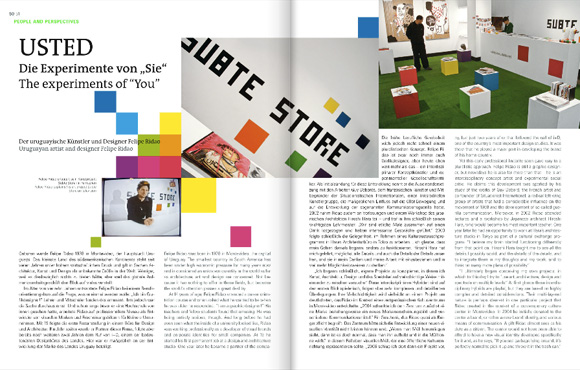
In this case visual garbage meant to represent a public cultural institution. “So in 2006 I proposed a project there, a kind of art salon. My own artistic contribution was the installation of a store like those you find at museums today. This culture center didn’t have anything like that. The art salon ultimately took place and a selection of ten artworks were judged. Includ ing my spatial intervention. I set up my allocated space like a regular store with a sales counter and used the corporate design I had already con ceived for the culture center. The camouflage was perfect.” The store and culture center formed a single visual unit. The items Ridao sold there in cluded the works of those artists rejected by the curators of the actual ex hibitions. In this quasiprivate space he had created within the public space of the culture center, he also organized his own events. The exhibi tion visitors did not perceive the border between art and reality. They saw Ridao not as an artist who had copied a museum store as part of an artistic installation, but a normal owner of a normal store. They asked him about works in the exhibition and bought the exhibition catalog from him, which in turn he had designed himself, and in which his store was present ed as a work in the exhibition. At first glance a pure prank – on closer in spection masterful mimicry, a game of confusion between art and reality and their ontological gray areas.
Experiments in art and communication such as this can be found throughout Ridao’s oeuvre, a collection of actions and collaborations with creative minds from all kinds of disciplines in Uruguay, as well as well known international figures such as Catalonian media artist Antoni Mun tadas and American graphic artist and former enfant terrible of typography David Carson. In 2006 Felipe Ridao founded “USTED” (Spanish for “You” ), a sort of open and mobile studio for all kinds of art, design and cultural projects and also the brand that represents him today. Felipe Ridao is “You”. He has been a mem ber of Laboratorio de Urbanismo Politico, or LUP, since 2008, which conceived Uru guay’s contribution to the 11th Architecture Biennial in venice that same year. LUP is a kind of think tank that focuses on the social dimensions of architecture.
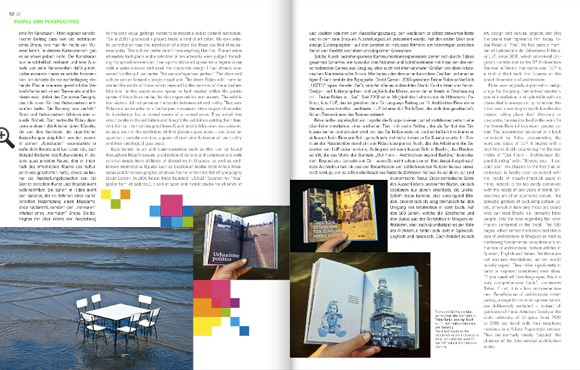
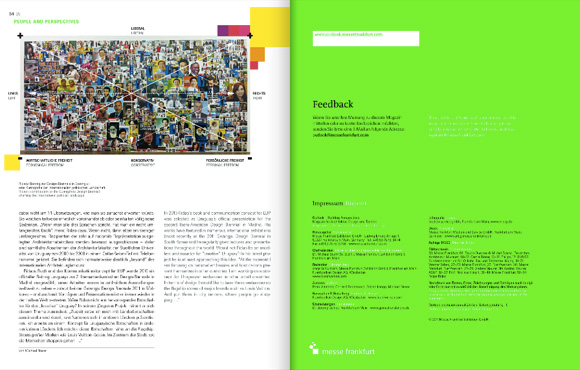
Ridao was originally supposed to design a logo for the group, but instead created a spatial installation, a simple table with six chairs that is always set up wherever the think tank is working to symbolize the dis cussion taking place. And ultimately, as cocurator, he was involved in the work for the venice Biennial to a much greater ex tent. The presentation centered on a book conceived by Ridao documenting the work and ideas of LUP. It begins with a brief line in Braille countering the Biennial motto of “Out There – Architecture Beyond Buildings” with: “Beyond you”. An allusion to the fact that architecture is hardly ever conceived with the needs of visuallyimpaired users in mind, indeed, is far too rarely conceived with the needs of any users in mind. Un less they are of an economic nature. This semiotic gesture of excluding certain users, of which in turn only those are aware who can read Braille, i.e. primarily blind people, sets the tone regarding the information contained in the book. The 500 pages, which reflect the history and status quo of architecture in Uruguay as well as containing fundamental considerations on the role of architecture, feature articles in Spanish, English and Italian. Yet these are not accurate translations, as we would initially expect. They differ significantly in parts or expound completely new ideas. “If you speak all three languages, this is a very comprehensive book”, comments Ridao. If not, it is a less comprehensive one. Beneficiaries of architectural navel gazing, a stage for national representation, are deliberately excluded – instead all graduates of the architecture faculty at the state university of Uruguay from 2000 to 2008 are listed with their telephone numbers in a Yellow Pagesstyle section. They are normally clearly “beyond” the glamour of the international architecture scene. In 2010 Ridao’s book and communication concept for LUP was selected as Uruguay’s official presentation for the second IberoAmerican Design Biennial in Madrid. His works have featured in numerous international exhibitions (most recently at the 2011 Gwangju Design Biennial in South Korea) and he regularly gives lectures and presentations throughout the world. Would not Ridao be an excel lent ambassador for “creative” Uruguay? In his latest project he is at least approaching this idea. “At the moment I am focusing on national embassies and how nations present themselves in other countries. I am working on a concept for Uruguayan embassies in other small countries. In terms of design I would like to base these embassies like the flagship stores of major brands such as Louis Vuitton. And put them in city centers, where people go shopping …”
Link: http://messelogo.de/outlook-nr-15/index.html
Outlook Magazine “Building Perspectives” Architektur, Design und Technik I Architecture, Design and Technology
ISSUE # 15 / 2012: “Smart Future”
Section: People & Perspectives
Pages: 50-54
Author: Michael Neser
Place: Frankfurt, Germany