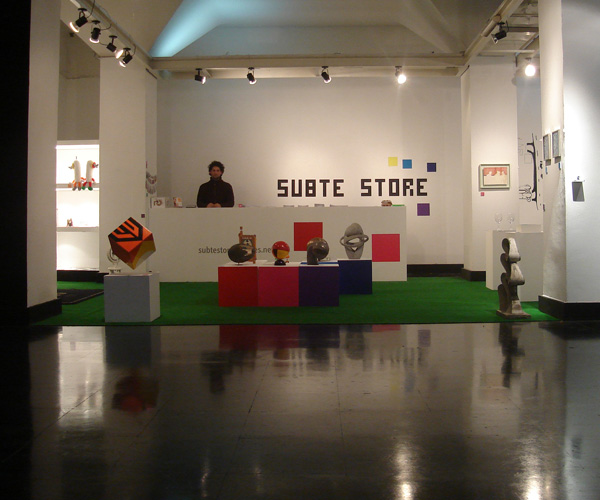
Brand for the art project that I presented at the award exhibition “Salón Anual Municipal de Artes Visuales 2007″. (project selected by jury: Alicia Haber -Uruguay-, Cecilia Brunson -Chile-, Eva Gringstein -Argentina-)
It is directly related with the logotype that I developed two years ago for the cultural centre where the exhibition was held.
The following text was part of an article about my doing “USTED – the experiments of “You” published in the section Section: People & Perspectives from the magazine: “Outlook ‘Building Perspectives’ Architektur, Design und Technik I Architecture, Design and Technology” by Michael Neser in 2012
“(…) “I ultimately began conceiving my own projects, in which to this day I try to fuse art, architecture, design and spectacle on multiple levels.”
At first glance these interdisciplinary hybrids are playful, but they are based on highly complex and detailed considerations. Their multilayered nature is perhaps clearest in one particular project that Ridao created in the context of a contemporary culture centre in Montevideo. In 2006 he initially donated to the centre a brand, or rather a new brand identity, and various means of communication. A gift Ridao almost sees as his duty as a citizen. The centre would not have been able to afford to have a new visual identity developed specifically for it and, as he says, “If you see garbage lying around, it’s perfectly normal to pick it up and throw it in the trash can.In this case visual garbage meant to represent a public cultural institution. “So in 2007 I proposed a project there, a kind of art salon. My own artistic contribution was the installation of a store like those you find at museums today. This culture centre didn’t have anything like that. The art salon ultimately took place and a selection of ten artworks were judged. Including my spatial intervention. I set up my allocated space like a regular store with a sales counter and used the corporate design I had already conceived for the culture centre The camouflage was perfect.” The store and culture centre formed a single visual unit. The items Ridao sold there included the works of those artists rejected by the curators of the actual exhibitions In this quasi private space he had created within the public space of the culture centre he also organised his own events. The exhibition visitors did not perceive the border between art and reality. They saw Ridao not as an artist who had copied a museum store as part of an artistic installation, but a normal owner of a normal store. They asked him about works in the exhibition and bought the exhibition catalog from him, which in turn he had designed himself, and in which his store was present ed as a work in the exhibition. At first glance a pure prank – on closer inspection masterful mimicry, a game of confusion between art and reality and their ontological grey areas. (…)”